
Why teamwork fail after every team building and what to do about it.

Chapter One. We are ok except that we are not
A team may attend a wonderful team-building programme.
They laugh together.
They play games together.
They communicate.
They discover their strengths.
They may even leave the programme saying:
“We are now one team.”
But the following Monday, they return to the same organization.

The same Personality differences are still there.
The same Workflow problems are still there.
The same unclear Roles and Responsibilities are still there.
And the same underlying Power Struggle may still exist.
Team building can create connection.
But connection alone does not fix an organization’s structural problems.
Chapter Two. Identify why teamwork fail
The purpose is not simply to ask:
“Is this team working well?”
It is to identify why the team is not working well.
Every problem has symptoms.
A team can have a common Goal and still fail because of the other four OEQ Pillars (Organization Effectiveness Quotient):
- Personality — Different personalities clash.
- Workflow — People have different ways of doing things.
- Roles and Responsibilities — Expectations are unclear or conflicting.
- Power Struggle — People compete for control, influence or recognition.
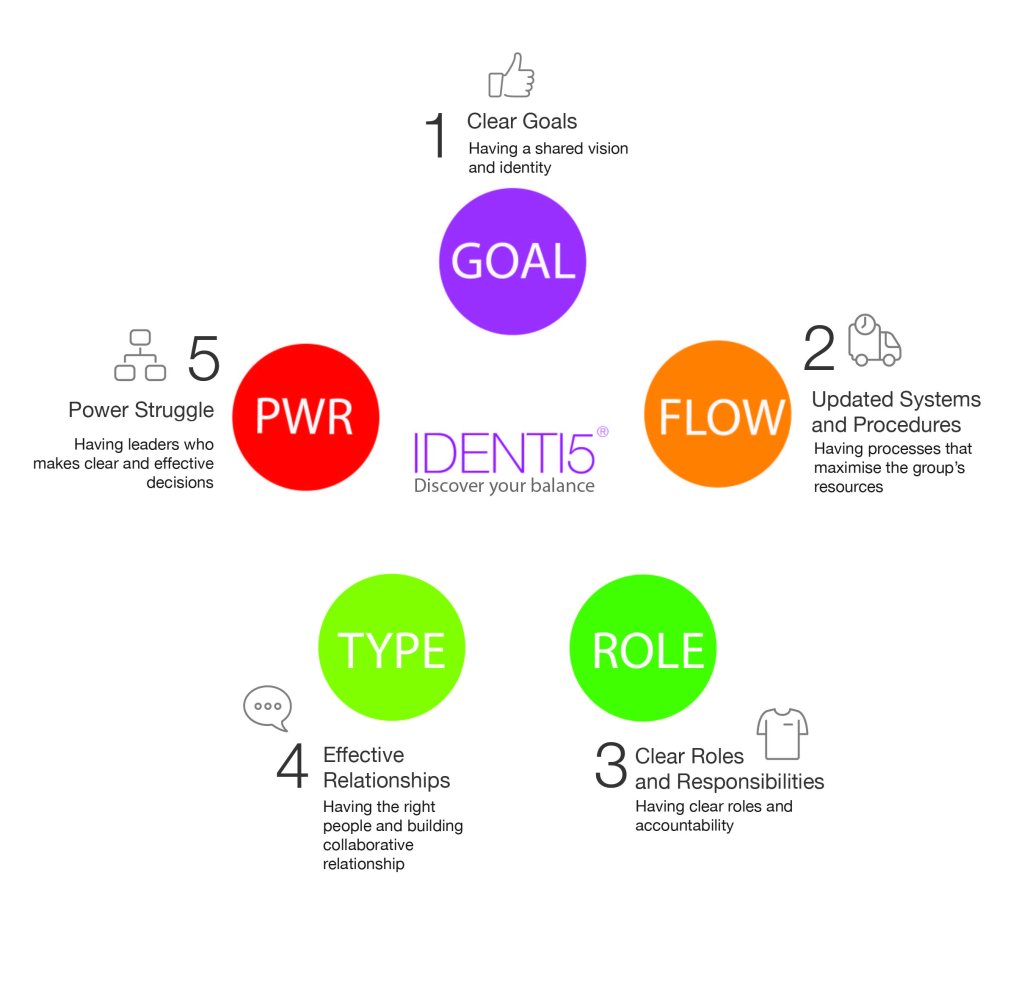
These five elements, including Goal alignment, form an important part of a framework that was learned during our Leadership training.
Team members should identify the OEQ pillars and list the Behaviors and that have previously created conflict or misunderstanding, and share them with one another in a neutral, constructive and encouraging manner.
- “I think we are unable to collaborate because your focus is … while mine is … (Goal misalignment).”
- “You like me to submit this report now… but from my perspective, it is more efficient for me if I complete … first (Workflow conflict)”
- “Why am I doing this when it was previously done by someone else (Roles and Responsibilities conflict).”
- “You asked XXX to stop helping me/ stop giving me the information I want. (Power Struggle).”
Teams should then identify the recommended Behaviors they would like to see from each other.
- “I was hoping that I can get your help in this area…”
- “Would you be able to do this in this particular way…?”
- “Could you rephrase your request in another way….?”
- “Is is possible that we… “
The purpose is not to blame or criticise, but to raise awareness of potential sources of conflict, clarify expectations, and encourage everyone to adopt Behaviors that create a more collaborative, supportive and effective team environment using the OEQ pillars.
Chapter 3. When team members don’t see the problem.
I have an activity prescribed specifically for this situation. Get four teams to cross to each other’s positions facing a certain set of requirements. Most teams cannot do so.
When you are standing in the cramp space, it is hard to see the solution among the ‘noise’. Later when we changed it to the paper drawings and using representations instead of actual people, we could see and understand the process clearly.
Learning point: Team members are often too close to the problem to see it.
They may think:
“It’s his Personality.”
“She doesn’t cooperate.”
“He never follows the Workflow.”
“She doesn’t understand her Role.”
“He is trying to take my Power.”

Everyone sees the problem from their own perspective.
This is where the Manager or Team Leader plays an important role.
A Manager has a more macro view of the team. Instead of taking sides, the Manager can identify whether the problem is related to Personality, Workflow, Roles and Responsibilities or Power Struggle.
The objective is to identify the symptoms early and rectify them before they become major problems.
Chapter 4: Solving the problems, layer by layer.
But what happens when the Manager cannot solve the problem?
The Manager should discuss it with another Team Leader or the relevant leader who can provide another perspective.
If the problem still cannot be resolved, it may indicate something deeper:
There could be a systemic issue or a legacy Workflow embedded within the organization.
At this point, the issue should be brought to Management.

Management must understand the concept of OEQ and recognise that some problems cannot be solved by simply asking people to “work better together.”
Sometimes, the people are not the problem.
The system is the problem.
Chapter 5. Learning to see the invisible.
A successful team-building programme should not be the end of the journey.
It should be the beginning..
Team members must learn to see the invisible: the small, seemingly insignificant Behaviors and interactions that often go unnoticed but gradually chip away at the foundation of a strong relationship (OEQ Pillars).
A delayed response, an unspoken expectation, a repeated habit, or a subtle change in attitude may appear harmless on its own. But when repeated, these tiny details accumulate.

Developing the ability to recognise these early warning signs allows people to address issues before frustration becomes conflict and conflict becomes a breakdown in trust.
The important exercise is not simply to ask:
“Who or which department is causing the problem?”
Instead, ask:
“What Behavior is creating the conflict, and what is the underlying OEQ issue?”
— Dr. Jace Tan
Fortune 500 Coach | Author | Corporate Trainer